My family was poor.
Not the kind of poor people talk about casually, but the kind where even a broken electric fan in the middle of summer could make the whole house fall silent for an entire evening because no one knew where the money to fix it would come from.
My father worked as a construction laborer. My mother sold vegetables at the local market. They had spent their whole lives doing hard, exhausting work. I could not remember a time when my mother’s hands were not rough and cracked, and my father’s back always seemed bent a little more with each passing year, his faded shirts carrying the smell of cement, dust, and sun.
Ever since I was little, they told me the same thing:
“We may be poor, but you must study.”
So I studied as if it were the only road out of the life we were living. When I was accepted into a university in the city, I cried with happiness. But right after that joy came something much heavier—tuition fees.
The day the admission letter arrived, I sat quietly in front of our house, staring at the number printed on the page. The amount felt enormous, almost impossible. I wanted to tell my parents that maybe I should wait another year, or find work first, or simply give up. But my mother waved the idea away immediately.
“If you got in, you go,” she said firmly. “Your father and I will handle the money.”
I knew what “we’ll handle it” meant.
It meant more early mornings. More late nights. More counting bills at the kitchen table under a dim light. More pretending not to be tired.
In the days that followed, I saw my mother leave for the market earlier than usual and come home later than before. My father started taking jobs at construction sites farther away, sometimes not returning until the sky had gone dark.
But as the deadline for tuition came closer, no one said anything.
I was so anxious I could barely sleep.
Then one morning, my mother placed a thick stack of money tied with a rubber band into my hands.
“Here,” she said. “Use this for your tuition.”
I stared at it, stunned.
“Where did this come from?” I asked.
She smiled and answered calmly,
“I borrowed it from someone I know.”
I believed her.
I never imagined she was hiding anything from me.
The four years I spent in college were four years of pressure, guilt, and determination. I studied hard because I felt I had no right to fail. I worked part-time jobs whenever I could—waiting tables at a café, tutoring children in the evenings, handing out flyers during summer breaks. I hardly spent money on myself. And every time I felt like giving up, I thought about the tuition money my mother had somehow managed to find for me, and I told myself I could not let her sacrifice be wasted.
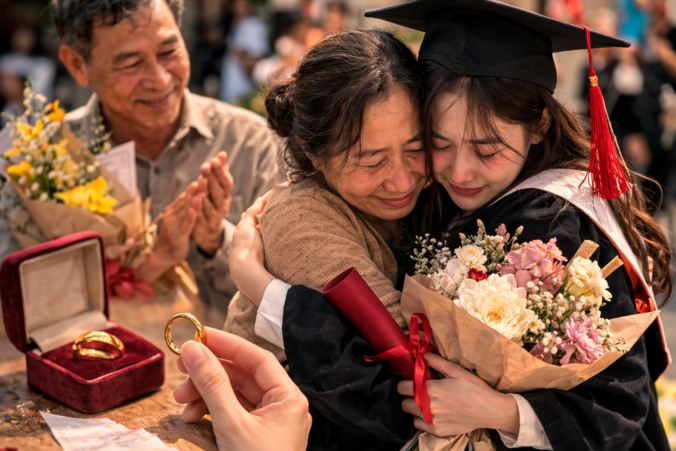
The day I graduated, my parents took a bus from our hometown to the city.
My mother wore the nicest outfit I had ever seen her wear—a floral blouse that was old but neatly ironed. My father wore a new pair of shoes, probably the first pair he had bought for himself in years.
When I walked out of the university gate in my graduation gown, my mother cried. My father smiled, but his eyes were red. It was the first time in my life that I truly felt I had done something meaningful for my family.
That night, we rented a cheap room near the bus station to stay in before they traveled home the next morning. While my mother was in the bathroom, I sat talking with my father. Somehow, the conversation drifted back to my first year at university.
“Dad,” I asked, “who did Mom borrow that money from back then?”
He was silent for a long time.
Then he said quietly,
“She didn’t borrow it from anyone.”
I looked at him, confused.
“Then where did the money come from?”
My father lowered his eyes to his calloused hands.
“She sold her wedding ring.”
I froze.
My mother had worn that thin gold ring for years. It had always been there on her finger, so ordinary and so familiar that I never thought much about it. But after I left for college, I realized I had stopped seeing it. Whenever I asked, she would just laugh and say that it got in the way while working. I had never questioned it further.
Now I understood.
My father spoke slowly, as if every word carried weight.
“The day your admission letter came, your mother stayed up all night. The next morning, she went to the jewelry shop by herself and sold the ring. It was the most valuable thing she owned. She told me not to tell you, because she was afraid you would feel guilty and refuse to go.”
I could not say a word.
That ring was not just a piece of gold.
It was part of their life together. It had survived years of hardship, poverty, sacrifice, and everything they had endured side by side. And my mother had given it up in silence just so I could sit in a classroom and build a future for myself.
When she came out of the bathroom a few minutes later, her hair was still damp, and her face looked as gentle as it always had. I stared at her—at the lines around her eyes, at her rough hands, at how much smaller and thinner she seemed than I remembered.
My chest tightened.
Then I burst into tears.
She looked startled.
“What’s wrong?” she asked quickly. “Are you tired?”
I threw my arms around her.
“Why didn’t you tell me?” I cried.
She was quiet for a moment, then she patted my back the way she had when I was a child.
“What would telling you have changed?” she asked softly. “As long as you became someone good, that was enough for me.”
I cried harder.
“But it was your wedding ring…”
She smiled gently.
“A ring can be bought again,” she said. “But if your future is lost, no one can buy that back for you.”
That sentence stayed with me for years.
Every time life became difficult, every time I felt like quitting, those words returned to me.
Three years after graduation, I finally had a stable job. When I received my first truly meaningful paycheck, I did the one thing I had promised myself ever since that night.
I took my parents to the city.
Then I led them into a small jewelry store.
My mother looked at me in confusion.
“What are we doing here?”
I reached into my pocket and took out a velvet box.
Inside was a pair of simple gold rings, modest but bright.
I placed the box in her hands and said,
“I can never repay all the years you and Dad gave up for me. But today, I want to return the thing you once quietly gave away because of me.”
My mother stood there, speechless, her hands trembling slightly.
My father turned his face away as if he were looking at the street outside, but I knew he was wiping tears from his eyes.
My mother gave me a half-scolding look and said,
“You shouldn’t have spent money on this.”
I smiled, even though my own eyes were burning.
“Because now,” I said, “I can finally do something for you.”
That day, as my father gently slipped the new ring onto my mother’s finger, I understood something I had been too young to fully understand before:
Family is not only the place that gives us food or shelter.
Family is the place where people are willing to give up the most precious thing they have so that we can have a future they never had.
And sometimes, we only grow old enough to understand the true cost of those silent sacrifices when it is almost too late to say thank you.