In eleventh grade, I used to think I had a lot of friends.
I was a good student, I spoke well in class, and I joined almost every group activity. Wherever I went, there was always someone calling my name, waving me over, saving me a seat. I had never imagined there would come a day when I would walk into my classroom and be met with whispers, cold stares, and the suffocating feeling that the entire world had quietly moved to the other side.
It all started with an anonymous post in our class group chat.
The post said I was fake. It said I only acted nice to get teachers to like me. It accused me of talking badly about my classmates behind their backs. It even claimed that I had deliberately stolen the class secretary position from someone else.
Underneath the post, the comments multiplied quickly. Some people called me two-faced. Others said they had “known it all along” and were just waiting for someone to finally say it out loud.
My hands were shaking when I read it.
What made it worse was that the post included details from our daily school life—details that sounded believable enough to make everyone think it had to be true. Overnight, I went from being someone people liked to someone people looked at with distrust.
The next morning, the moment I stepped into the classroom, I felt it.
The air was cold, heavy, and strange.
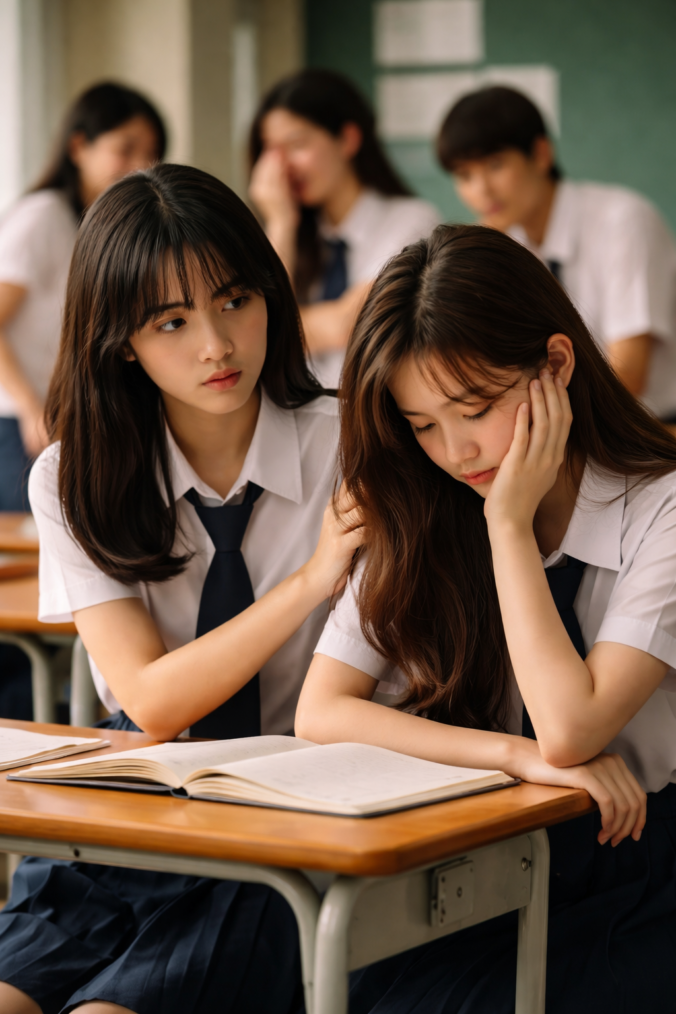
People who used to chat with me every day now suddenly avoided eye contact. A few of them lowered their voices when I walked past. Even Ha, my closest friend, only looked at me for a second before quickly looking away.
I sat down in my seat and tried to act normal, but under the desk, my fingers were clenched so tightly that my nails dug into my skin.
Only one person in that room did not look at me the way everyone else did.
It was My—the girl I had never really liked.
My was smarter than me, quieter than me, and far more distant than anyone else in class. She rarely got involved in gossip, barely spoke unless it was necessary, and always gave off the impression that she simply didn’t care whether people liked her or not. I had always thought she was arrogant. To be honest, I had often felt irritated by her. Every time a teacher assigned something important, My would do it so perfectly that the rest of us looked clumsy beside her.
That morning, while the whole class was whispering and watching me out of the corners of their eyes, My suddenly stood up.
“If no one has proof,” she said coldly, “then stop looking at someone like she’s guilty.”
The classroom went silent.
A boy in the front row let out a short laugh.
“But the post was pretty specific,” he said.
My turned to look at him directly.
“Specific doesn’t mean true.”
Someone else spoke up.
“But a lot of people think it sounds believable.”
My didn’t hesitate.
“‘A lot of people think so’ isn’t the same thing as the truth,” she said. “It just means a lot of people are willing to follow a crowd.”
The whole room fell completely still.
I looked up at her, stunned.
I had never imagined that if anyone ever defended me, it would be her.
During break, I followed her out into the hallway.
“Thank you,” I said quietly.
She kept walking without looking at me.
“I’m not defending you,” she replied. “I just hate group bullying.”
I stopped in my tracks, feeling embarrassed and grateful at the same time.
The days that followed were some of the hardest days of my life.
People no longer talked to me the way they used to. I sat in class feeling like an outsider in my own life. Sometimes I locked myself in the bathroom during breaks just to cry where no one could see me. I didn’t know how to defend myself against something as poisonous as suspicion. There was no real evidence, but there was something almost worse—people’s willingness to believe the worst about me.
The only person who treated me normally was My.
She never made a big deal out of it. She never tried to comfort me with dramatic words. But sometimes she would leave a bottle of water on my desk. Sometimes she would slide her notes over if I missed something in class. When I had a fever and couldn’t focus, she quietly handed me the homework list before leaving school.
One afternoon after class, she suddenly asked me,
“Do you want to find out who wrote the post?”
I nodded immediately.
It turned out that My had already been suspicious for a while. She said the writing style in the post felt familiar. Certain phrases and expressions sounded exactly like Ha, my best friend.
I was shocked.
Ha and I had been close since middle school. She knew my secrets, my fears, the things I never told anyone else. I couldn’t believe she could be the one behind something like this.
But once My said it, little details I had ignored started to come back to me.
Ha had changed after our homeroom teacher selected me to represent the class in an academic competition—a position she had always assumed would be hers. I had never realized she had carried that resentment inside her. I thought she had been happy for me. I thought she was my friend.
After almost a week, My found proof.
Another classmate had accidentally seen Ha using a secondary account—the same one that matched the anonymous profile from the post. When people confronted her, she broke down crying and admitted everything.
That day, the classroom was so quiet you could hear the ceiling fan turning above us.
Ha cried and cried as she spoke.
“I only wanted people to dislike you for a little while,” she said. “I didn’t think it would get this bad.”
I stood there staring at the person I had trusted most, and I felt something inside me ache in a way I had never known before.
I realized then that the worst kind of hurt doesn’t always come from strangers. Sometimes it comes from the people you trusted enough to hand your heart to.
After that, many of my classmates apologized.
Some said they had been too quick to judge. Some admitted they had followed the comments because everyone else was doing the same. Some avoided the topic completely because they were too ashamed to talk about it.
But the person I kept thinking about was My.
I had disliked her because she was distant. I had judged her because she was quiet. I had assumed that someone who wasn’t warm or friendly on the surface would never stand by me when it mattered.
I was wrong.
In the end, the person who protected my dignity and helped me hold on to the truth was the girl I had understood the least.
At the end of eleventh grade, during our class closing ceremony, our homeroom teacher said something I have never forgotten.
“You may forget a lot of things after you leave school,” she told us, “but remember this: true friendship is not about who is always beside you when life is easy. It is about who dares to stand beside you when everyone else turns away.”
I turned to look at My.
She was sitting there as usual, back straight, expression calm, almost as if none of it mattered to her at all.
After school that day, I slipped a small note into her hand.
On it, I had written only one sentence:
Thank you for believing me when the rest of the world didn’t.
She read it, then looked at me and gave a small smile.
“Don’t be so dramatic,” she said.
I laughed, even though my eyes were burning.
And from that day on, I understood something I had been too young to understand before:
Friendship does not always begin with closeness.
Sometimes, it begins with the one person who is brave enough to speak one fair sentence for you while everyone else chooses silence.